
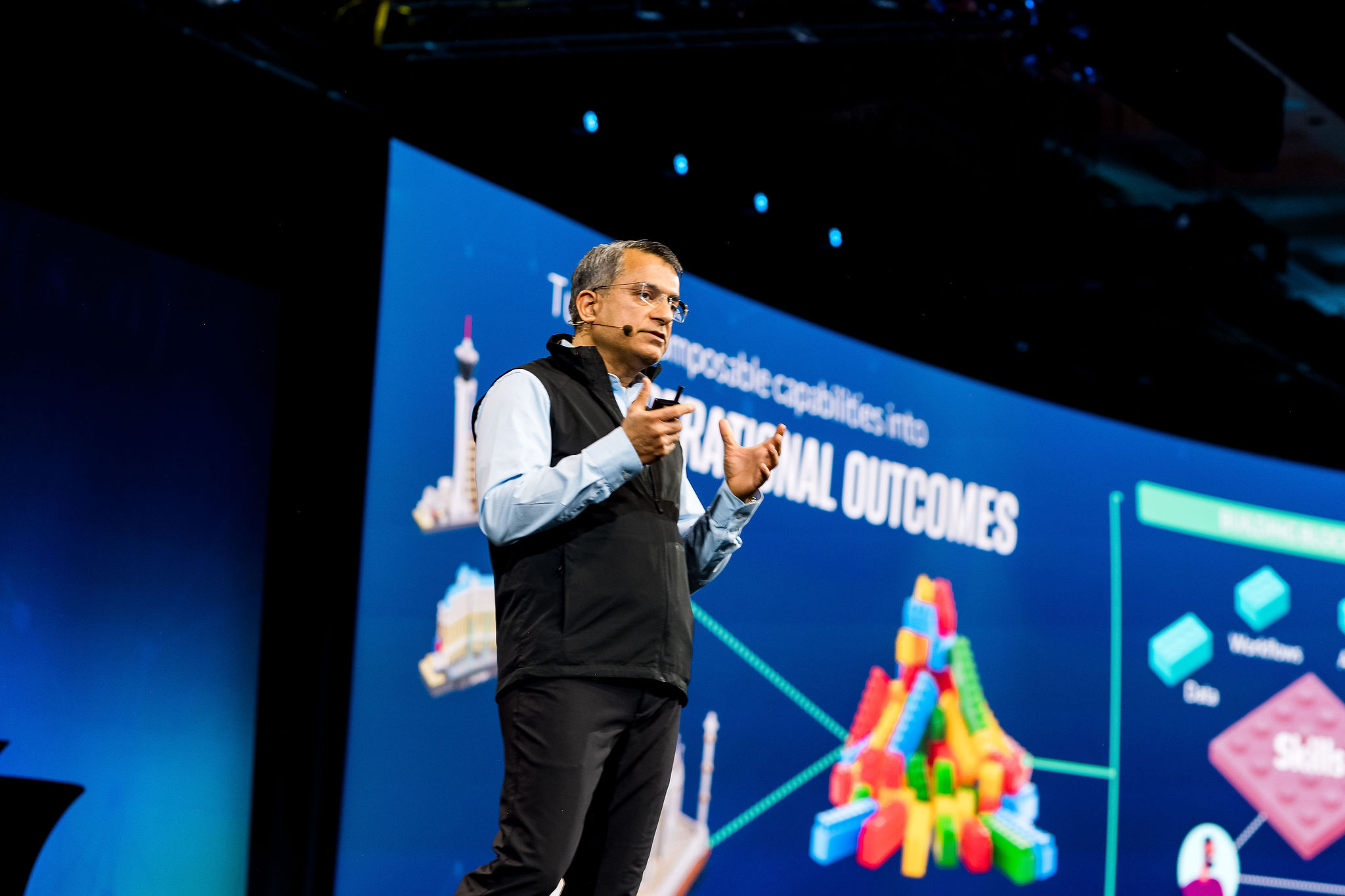

AI has moved well beyond experimentation.
Across industries, companies are investing heavily in AI to improve planning, automate processes, and help employees make better decisions. The potential is enormous. Yet many organizations are discovering a fundamental challenge:
Knowing what AI can do is very different from operationalizing it.
The next wave of enterprise transformation will not come from adding another AI application or deploying another copilot. It will come from embedding intelligence into the way the enterprise operates — continuously sensing what is changing, understanding what it means, deciding what to do, and acting on those decisions.
At Kinaxis, we call this operational orchestration.
It is the evolution from AI that assists with individual tasks to AI that becomes part of the enterprise operating model.
The supply chain is an ideal example.
Every day, organizations generate enormous amounts of signals: customer demand, orders, inventory movements, supplier updates, transportation events, weather, geopolitical developments, tariffs, conversations, documents, and market changes.
The challenge is no longer access to data or even access to AI.
The challenge is connecting those signals to business context, decisions, and actions.
A disruption does not happen in isolation. A supplier delay can affect production, which affects inventory, customer commitments, revenue, and ultimately business performance. Understanding that chain of consequences requires more than a model. It requires an intelligence layer that understands the physics of the enterprise.
That is where the Kinaxis operational orchestration changes the equation.
The new operating model: Always listening. Always understanding. Always deciding. Always improving.
Imagine an enterprise that is continuously aware of what is happening around it — and increasingly capable of determining what it means and what to do next.
That operating model has four characteristics:
Always listening
The enterprise continuously captures signals from across its ecosystem.
Demand changes. A supplier misses a commitment. A port closes. A tariff changes. A customer changes its buying pattern. A competitor launches a product.
AI can now listen across structured and unstructured data, internal and external signals, transactions, documents, conversations, and events.
But listening is only the beginning.
Always understanding
Signals become valuable when they are interpreted in context.
AI needs to understand the relationships between products, customers, suppliers, facilities, inventory, capacity, constraints, financial objectives and business priorities.
Every enterprise has a unique operational fingerprint.
That is why the future of enterprise AI cannot be built on generic intelligence alone. AI needs a semantic understanding of the business — an intelligence layer that connects data to the way the enterprise actually operates.
This is what turns information into enterprise intelligence.
Always deciding
Understanding creates the foundation for action.
AI can evaluate alternatives, simulate scenarios and determine the best response using the right combination of enterprise intelligence, optimization, business rules, foundation models and specialized models.
And increasingly, AI does not stop at recommending an action.
It can initiate and orchestrate the response.
That is a fundamental shift: from insight to decision, and from decision to execution all synchronized with no latency.
Always improving
Every action creates another learning opportunity.
What happened? What decision was made? What was the outcome? Did the response achieve the intended business objective?
The enterprise can continuously learn from those outcomes and improve how it senses, understands, and decides.
This creates a fundamentally different model of enterprise AI — one that becomes more valuable through use rather than remaining a collection of disconnected experiments.
From applications to an intelligence layer
This is also why I believe the next evolution of enterprise AI is bigger than deploying AI applications.
Organizations will increasingly need an enterprise intelligence layer that spans applications, data, processes, and functions.
It becomes the connective tissue between the signals the enterprise receives, the context it understands, the decisions it makes and the actions it takes.
And it provides the foundation for a new generation of AI agents.
Agents become significantly more powerful when they are not operating in isolation — when they can understand enterprise context, access the right intelligence, reason over constraints, interact with existing systems, and orchestrate actions toward measurable outcomes.
This is the path from individual AI capabilities to an agentic enterprise.
The acceleration has already begun
What makes this moment different is not simply the advancement of AI models.
It is the speed at which these capabilities can now be engineered into real enterprise workflows.
At Kinaxis, we have been on this journey with customers — moving from concepts around AI and operational orchestration into capabilities that can be applied to real supply chain decisions and real business outcomes.
The pace of engineering matters.
What once required years of transformation can increasingly be developed, tested and operationalized in much shorter cycles. That creates a new relationship between innovation and execution: experiment, learn, engineer, deploy — and continuously improve.
This is how AI moves from the innovation lab into the operating core of the enterprise.
The future is not more AI. It's AI that operates.
It means rethinking how an enterprise senses change, understands its implications, makes decisions, and executes responses.
For leaders, this creates the opportunity to move from reacting to exceptions toward an enterprise that is continuously aware, continuously deciding, and continuously adapting.
The future of AI will not be defined by how many AI tools an organization deploys.
It will be defined by how deeply intelligence becomes embedded in the way the enterprise operates.
Always listening.
Always understanding.
Always deciding.
Always improving.
That is the promise of Kinaxis operational orchestration — and the foundation for the next generation of the intelligent, agentic enterprise.