


AI bubble is one of the top trending terms in AI circles today. When Mark Zuckerberg warned that “AI hype will fade just as fast as it rose if companies don’t focus on real value,” and Sam Altman added that “most of what people are calling AI transformation today isn’t transformation at all,” they were pointing to a growing truth: many industries are rushing in without preparing for what comes next. This lack of preparedness is what is fueling the AI bubble.
Across sectors, companies are racing to experiment with generative AI and automation. However, in the rush, most are skipping the more challenging, yet less glamorous, tasks: cleaning data, building trust, and shaping culture.
The supply chains that dominate 2030 won’t just use AI, they’ll think, act, and adapt like AI. Their edge will come from disciplined data, united people, and a mindset wired for progress. They’ll be the ones who start the right foundations now with a vision for the future.
The stakes & vision: Why 2030 will be a test of readiness
The supply chain landscape is changing faster than ever. Disruption, transparency, and technology are reshaping how products are planned, sourced, and delivered. The image below highlights the key factors driving this change.
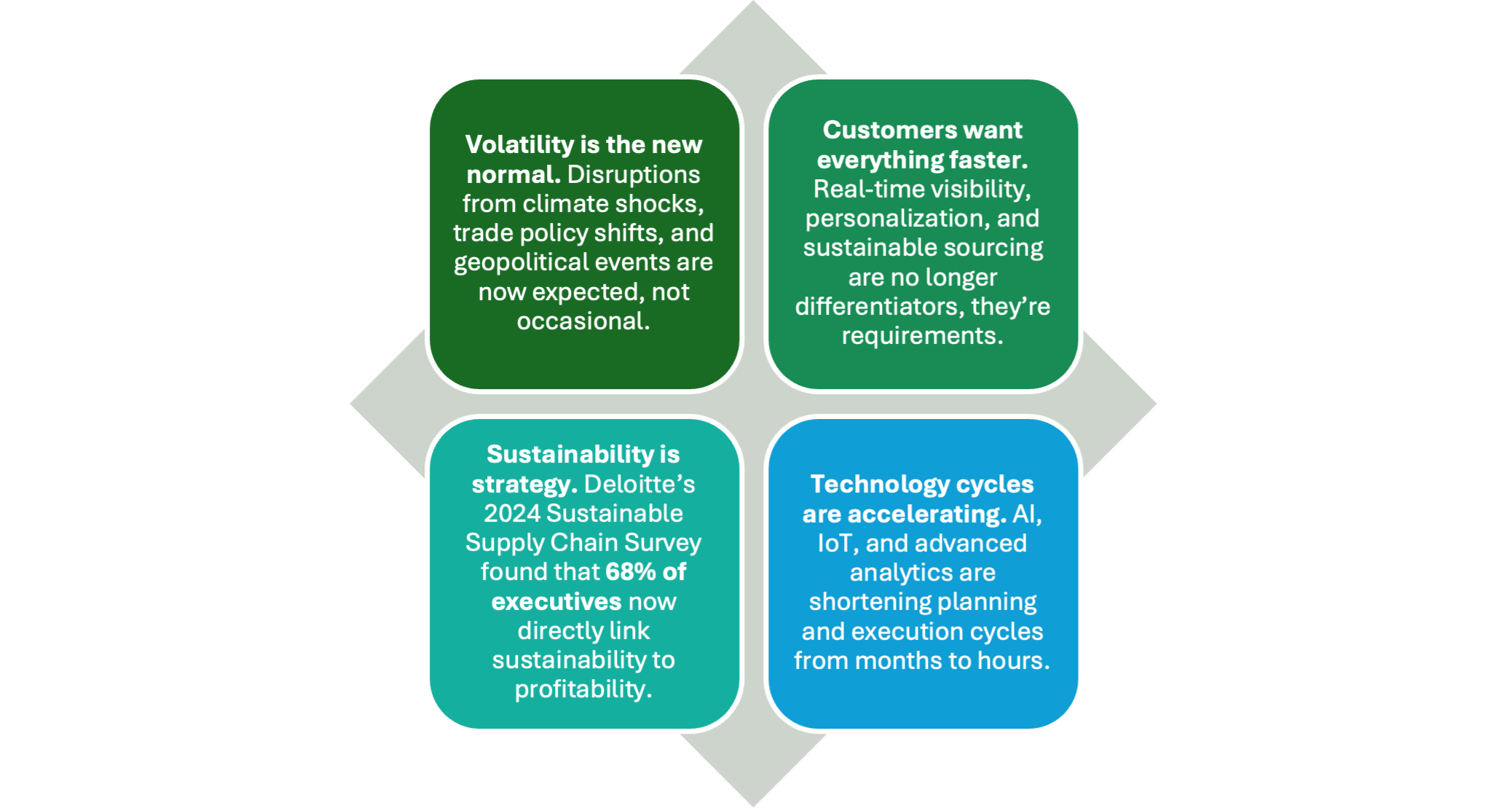
By 2028, three-fourths of supply chain organizations are going to restructure their operations around AI-enabled decision systems. The lesson: cost control and process tweaks will no longer be enough. Supply chains that win will be data-rich, insight-driven, and culturally agile.
What it takes: Data foundations
AI is only as effective as the data behind it. Without clean, connected, and well-governed data, even the most advanced algorithms can deliver misleading results.
Building the foundation means:
- Clean, integrated, and timely data: Create a clean and trusted data source by removing duplicates, aligning master data, and standardizing formats across systems, processes, and business units.
- Governance that scales: Establish clear ownership, enforce quality controls, and define escalation paths for data issues.
- End-to-end visibility: Companies with transparent data flows are 2.5x more resilient during disruptions. Strengthen visibility with digital twins and AI-enabled advance planning systems that convert real-time data into proactive decisions.
- Breaking down silos: Shared platforms, unified KPIs, and integrated workflows transform fragmented functions into a single, coordinated, data-driven operation.
Poor data quality can erode an organization's productivity before a single AI tool is even deployed.
What it takes: AI culture and capability
Technology alone can’t transform an organization that isn’t ready to evolve. For AI to deliver impact, it needs an environment where people trust the data, collaborate freely, and adapt quickly.
Here’s what sets winning organizations apart:
- Leaders who learn: Foster experimentation, encourage pilot projects, and view early failures as lessons that accelerate progress.
- Cross-functional collaboration: Supply chain, operations, and data teams must operate as one ecosystem, where insights flow freely, decisions are shared, and innovation happens faster.
- Responsible AI governance: Define how AI makes decisions, how those decisions are validated, and how outcomes are explained. Transparency builds trust in both the technology and its results.
- Upskilling and mindset evolution: According to Gartner, 67% of supply chain leaders cite “skills and mindset” as their most significant barrier to AI adoption.1 Building confidence in data-driven decision making is just as vital as deploying the tool.
- Aligned incentives that drive unity: Reward collective results over individual KPIs. When success is shared, collaboration becomes instinctive.
When culture and capability align, AI stops being a buzzword and starts becoming a competitive weapon.
Path and roadmap: Turning vision into readiness
AI readiness is not a one-time initiative or a quick fix. It is a journey that matures over time. Leaders should aim to create momentum that compounds, linking today’s actions to tomorrow’s advantage.
Short term: Build trust and show results
The first step in defining a short-term plan is to fix the critical issues while finishing a few easy wins. Prioritize data cleanup, data governance, and ensure decisions are based on facts. Early, visible results help people believe in the change.
Midterm: Connect and expand
Once the basics are stable, bring together separate systems and teams. Establish shared data standards, enhance governance, and foster collaboration between business and technical experts. The aim here is to make good practices repeatable and scalable.
Long term: Embed and adapt
Over time, insights and automation become part of everyday work. Data is treated as an asset that keeps improving, and governance becomes second nature. The organization continues to learn and adjust as new tools and challenges emerge.
A roadmap like this isn’t set in stone. It evolves with experience. Companies that continually learn, refine, and connect their data and people will shape the next era of supply-chain performance.
| Trusted data | Explainable AI | Empowered people | Learning culture |
| Shared, visible, and real-time | Transparent and auditable decisions | Trained and trusted to act on data | Innovation as a continuous cycle |
The next five years
By 2030, the companies leading global supply chains may not be the biggest or the most automated. The real frontrunners will be the ones who treated information as a core business asset and built a culture strong enough to turn technology into long-term value.
The message is simple: don’t chase the hype. Focus on what endures: precise data, steady execution, and people who know how to learn faster than the market changes. That’s how a supply chain stays ahead when the next wave of AI comes.
About the author
Karthick Sarma
Supply Chain Data Lead, Bluecrux
With over 12 years of experience transforming global supply chains through data, Karthick Sarma helps leading organizations design and implement data strategies, governance frameworks, and advanced planning system (APS) enablement that enhance performance, compliance, and trust in data-driven decisions.
As Supply Chain Data Lead at Bluecrux and a Doctoral Candidate in Data Analytics, Karthick combines deep technical expertise with strategic insight to advance the role of data in modern supply chains. He was recognized with the Indian Achievers Award 2025 for his contributions to data leadership.